

ROAD Pathway
Resources and Options for Alcohol Drinking in Central Vermont
Here to support our community.
The Resources and Options for Alcohol Drinking (ROAD) Pathway was created to address gaps in Alcohol Use Disorder care by improving screening, treatment access, and coordinated recovery support in Central Vermont.
The ROAD Pathway supports patients, healthcare providers, and community partners by improving how Alcohol Use Disorder (AUD) is identified, treated, and supported across Central Vermont.
Who are we supporting?

Why We Need a Better Pathway for AUD
-
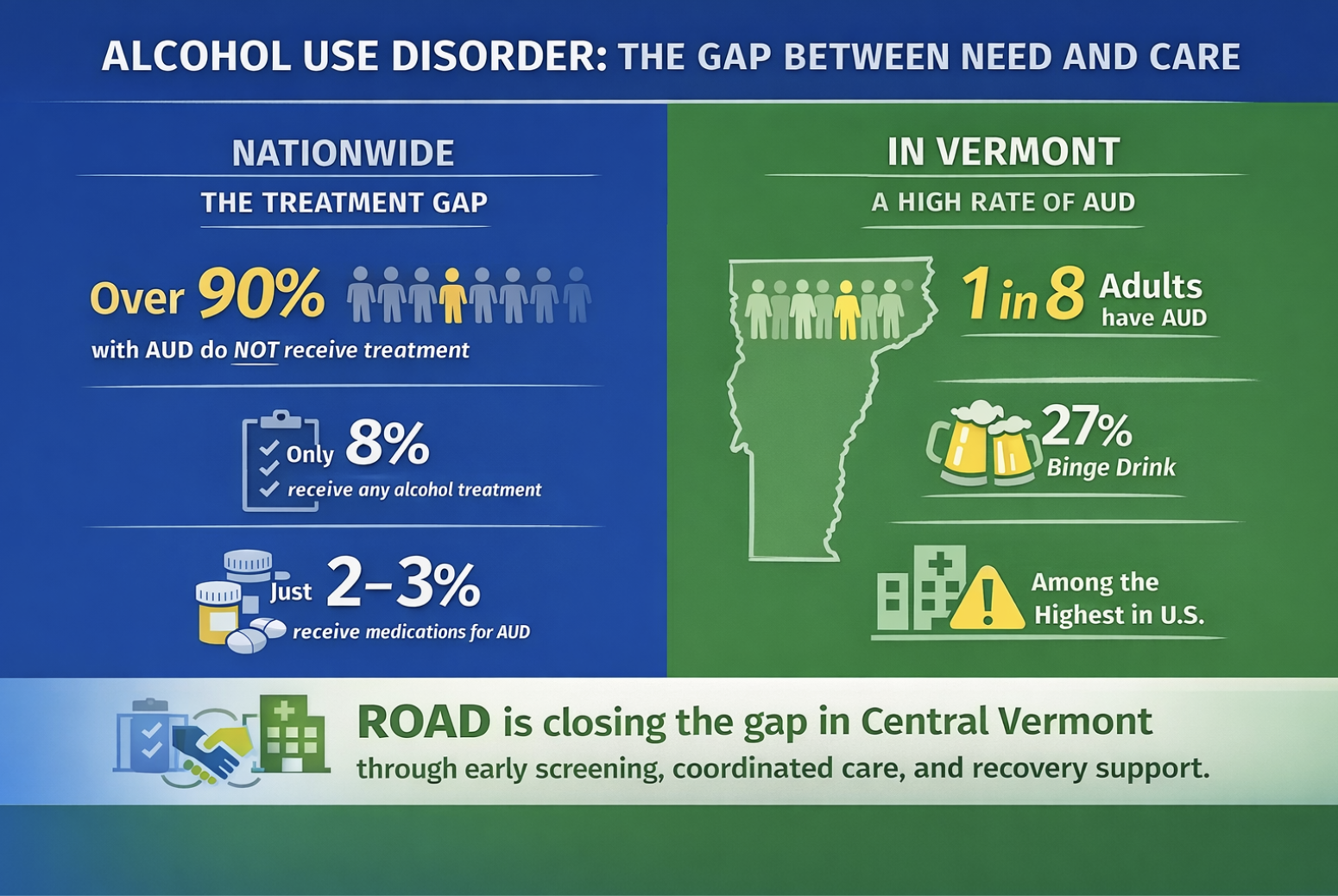
Alcohol Use Disorder affects millions of people across the United States, yet most individuals who meet criteria for AUD never receive evidence-based treatment. According to recent national surveys:
Only 7.8–7.9% of adults with past-year AUD received any alcohol use treatment in a given year—meaning over 90% go untreated NIAAA
Medication-assisted treatment for AUD, an evidence-based option, is used by only 2.4–2.5% of adults with past-year AUD NIAAA
These gaps reflect longstanding challenges in awareness, screening, referral, and access to care for people with Alcohol Use Disorder.
-
Alcohol misuse and Alcohol Use Disorder are particularly significant public health concerns in Vermont:
Vermont consistently ranks among the highest states in the U.S. for binge drinking and excessive alcohol consumption VTDigger SAMHSA
Approximately 12% of Vermont adults meet criteria for AUD—higher than national averages WCAX
About 27% of Vermont adults report binge drinking, among the highest rates nationally VTDigger
More than 60% of Vermont adults report recent alcohol use, exceeding national averages WCAX
These patterns underscore the need for better screening, early identification, and rapid linkage to treatment—especially in rural and underserved areas.
Together, these national and state trends made it clear that a more proactive, coordinated approach to Alcohol Use Disorder was urgently needed in Central Vermont.
How ROAD Began: From Data to Action
In 2020, as the COVID-19 pandemic unfolded, local and national data showed a sharp rise in alcohol use and Alcohol Use Disorder. At the same time, gaps in screening, treatment, and follow-up became increasingly visible across emergency and primary care settings.
In response, Central Vermont Prevention Coalition convened a multidisciplinary group of partners, including an Emergency Department physician, case managers, recovery coaches from Turning Point Peer Recovery Center, a primary care provider, and Treatment Associates (now Center for Substance Use Services, CSUS). Together, this group committed to building a more coordinated, proactive approach to identifying and treating Alcohol Use Disorder.
ROAD was intentionally designed to treat Alcohol Use Disorder as a chronic, treatable condition across settings—not only during moments of crisis.
The initial focus of ROAD was the Emergency Department, where many individuals with AUD first present during moments of crisis. Historically, care often focused on managing acute alcohol withdrawal without addressing the underlying disorder.
Through ROAD, this approach shifted. The team improved evaluation and treatment processes in the ED, expanded access to medications for AUD, and supported discharging patients with medication treatment in place when appropriate—along with clear linkage to ongoing care and recovery supports.
Improving Care in the Emergency Department
As part of this coordinated effort, Treatment Associates developed an Intensive Outpatient Program (IOP) specifically for individuals with Alcohol Use Disorder, expanding access to structured, evidence-based care for patients.
This ensured that individuals identified in the Emergency Department or other settings could transition quickly into appropriate levels of care within the community.
Expanding Treatment Options
Recognizing that most people with Alcohol Use Disorder are seen regularly in primary care, the ROAD team turned its focus to improving AUD treatment within primary care practices.
The team conducted a survey of primary care providers to assess barriers, needs, and opportunities for improvement. These findings informed the development of a Primary Care Alcohol Use Care Pathway, designed to support screening, treatment decision-making, and referral within routine medical care.
This pathway was later adopted by the UVM Health Network and the High Value Care Initiative, extending its impact beyond Central Vermont.
Strengthening AUD Treatment in Primary Care
To support implementation, the ROAD team offered continuing education opportunities to increase provider knowledge, comfort, and confidence in treating Alcohol Use Disorder within primary care.
The team also met in person with each primary care practice, introducing ROAD partners and, importantly, recovery coaches from Turning Point. These relationships helped normalize peer recovery support as part of routine medical care.
To further reduce barriers, a streamlined process was created within the electronic medical record (EPIC), allowing providers to message recovery coaches directly and connect patients to support quickly and seamlessly
Building Provider Confidence & Connection
The Role of Recovery Coaches
Recovery coaches are a cornerstone of the ROAD Pathway. By engaging patients early and remaining involved across transitions in care, recovery coaches help reduce barriers, close gaps between systems, and support sustained engagement in treatment and recovery.
Their integration into both emergency and primary care settings has strengthened continuity of care, reduced stigma, and improved patient experiences.
Continuing to Grow
ROAD continues to evolve. Central Vermont Prevention Coalition and its partners are expanding medication options within primary care, strengthening coordination across systems, and using data to guide continuous quality improvement.
What began as a response to alarming trends during the pandemic has grown into a comprehensive, collaborative pathway—one that improves access to evidence-based treatment, strengthens continuity of care, and treats Alcohol Use Disorder with the urgency, compassion, and coordination it deserves.
We’re here to support you.
If you or someone you know is looking for support, contact CVMC Addiction Support 802-371-4875, Center for Substance Use Services 802-225-8355, or Turning Point of Central Vermont 802-622-0251.